
How to Get Rid of Mice Without Poison: 6 Proven Methods
Table of Contents
- Why Non-Poison Mouse Control Works Better Than You Think
- Signs of a Mouse Infestation: Confirm the Problem First
- How to Seal Gaps to Stop Mice Getting In
- Pet-Safe Mouse Traps: Snap Traps, Live Traps and What Works
- Tracking and Monitoring: Find Where Mice Are Moving
- How Long Does It Take to Get Rid of Mice Without Poison?
- When to Call a Professional for Mice Without Poison
- Conclusion: A Clear Plan Beats Guesswork
- Frequently Asked Questions
Last Updated: 16 October 2026
Why Non-Poison Mouse Control Works Better Than You Think
Getting rid of mice without poison comes down to three things: proofing your home, trapping what is already inside, and tracking activity so you know the job is done. Poison looks like the fast option, but it leaves mice dying in wall cavities and puts pets and children at risk. At Military Precision Pest Control, we built our kits around a different idea: find the problem, seal the entry, remove the mice, then prove the house is clear.
Mice that eat rodenticide often die behind skirting boards, under floorboards, or inside wall voids. The smell can linger for weeks, and you cannot tell whether the infestation has actually ended. Traps and proofing give you something poison never does: visible proof.
Our approach follows a simple sequence: confirm, seal, trap, monitor. If you trap first without sealing, new mice keep walking in through the same gap. If you seal first without confirming, you may trap mice inside the walls with no way out. The UK Health Security Agency guidance on rodent control is clear that proofing and hygiene, not just removal, are what prevent repeat problems.
Signs of a Mouse Infestation: Confirm the Problem First
The clearest signs of a mouse infestation are droppings, grease marks along walls, gnawed packaging, and scratching sounds at night. Mice leave dark droppings about the size of a grain of rice, usually near food sources and skirting boards. You may also notice a musty smell in cupboards or a pet staring at a wall for no clear reason.
Check these spots first:
- Behind the fridge and washing machine
- Under the kitchen sink and inside low cupboards
- Along skirting boards and behind furniture
- In loft insulation and airing cupboards
- Near pet food bowls and bin stores
One mouse produces dozens of droppings a day, so fresh evidence builds up fast. A common mistake is assuming one dropping means one mouse. In practice, a visible trail usually means several animals are using the same route.
If you are unsure whether you have mice or something larger, size helps. Mouse droppings are small and pointed. Rat droppings are noticeably bigger and blunt-ended. When in doubt, track before you treat. Our Rodent Tracking & Monitoring Kit uses UV powder and a torch to show exactly where rodents are moving, which takes the guesswork out of identification.

How to Seal Gaps to Stop Mice Getting In
Sealing gaps is the single most effective step in any non-poison plan. A mouse can squeeze through a gap the width of a pencil, roughly 6mm, so small openings matter. Walk the outside of your home and check where pipes, cables, and vents enter the walls.
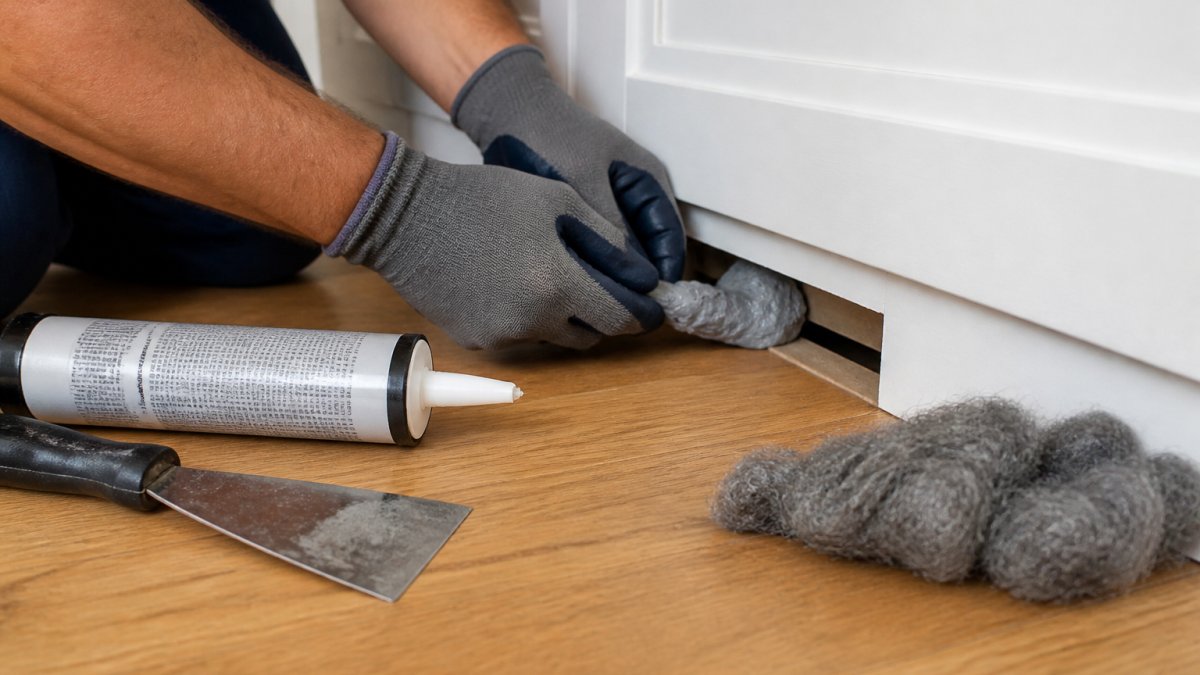
Work through these areas:
- Gaps around gas, water, and drainage pipes
- Air bricks and ventilation openings
- Gaps under external doors, including garage doors
- Cracks in brickwork and around window frames
- Spaces where services enter the loft
For small gaps, wire wool packed tightly then covered with proofing paste works well. For larger holes, repair cement fills the space and sets hard. Our Rodent Proofing Kit includes proofing paste, repair cement, wire wool, and work gloves so you have everything in one box.

Pet-Safe Mouse Traps: Snap Traps, Live Traps and What Works
Pet-safe mouse traps fall into two main types: enclosed snap traps and live traps. Enclosed snap traps sit inside a tamper-resistant station, so pets and children cannot reach the mechanism. Live traps catch mice unharmed so you can release them, but they need checking daily.
Here is how the main options compare:
| Trap type | How it works | Best for | Main drawback |
|---|---|---|---|
| Enclosed snap trap | Kills quickly inside a station | Most homes with pets | Must be checked daily |
| Live catch trap | Catches alive for release | People who want no killing | Stressful for the mouse; release rules apply |
| Traditional snap trap | Kills on contact, exposed | Lofts and outbuildings | Risky near pets and children |
| Glue board | Holds the mouse in place | Not recommended | Inhumane and banned in many places |
Enclosed stations are a practical choice for many households. The mouse enters through a small opening, the trap fires inside, and you never touch the animal. Our Mouse Snap Trap Kit pairs two breakback traps with secured SnapBox stations, plus UV tracking powder and a torch so you can confirm results.

Bait choice matters less than placement. Mice run along walls, so set traps with the trigger end against the skirting board, not out in the open. Peanut butter and chocolate work well because they smell strong and hold firm to the trigger.
Tracking and Monitoring: Find Where Mice Are Moving
Tracking tells you whether your plan is working. Without it, you are guessing. UV tracking powder shows footprints and tail trails under a UV torch, revealing routes you would never spot in normal light.
Use tracking in three stages:
Mouse Snap Trap Kit - Indoor →
- Before trapping, to find the main runways and entry points
- During trapping, to confirm which areas are still active
- After trapping, to prove activity has stopped
Dust a light layer of powder along a suspected route, leave it overnight, then check with the torch. Fresh trails mean active mice. No trails for several nights running is a good sign.
How Long Does It Take to Get Rid of Mice Without Poison?
Most homes see a clear drop in activity within two to four weeks when proofing and trapping run together. The exact time depends on how many mice are inside and how well the building has been sealed. A single mouse caught early is a matter of days. A long-running infestation in an old property takes longer.
Expect this rough timeline:
- Week 1: seal entry points, set traps, start tracking
- Week 2: check traps daily, move them to active runs
- Weeks 3 to 4: monitor for fresh signs, re-seal any gaps you missed
The trap line is your measure of success. When catches stop and tracking shows no new trails, you are likely clear. Keep monitoring for another fortnight before you call it done, because a missed entry point can let a new mouse in within days.
When to Call a Professional for Mice Without Poison
Call a professional when you have sealed and trapped for several weeks with no progress, or when mice keep returning after you thought the problem was solved. Recurring activity usually means an entry point you have not found, or a route through a shared wall or loft space.
Signs it is time to bring in help:
- Fresh droppings after weeks of trapping
- Activity in multiple rooms at once
- Mice in a flat or terraced home, where the source may be next door
- Damage to wiring, pipework, or insulation
A professional survey maps the full building, not just the obvious rooms. It also checks lofts, voids, and shared service runs. Where a landlord or managing agent is responsible for the structure, the government guidance on repairing responsibilities in rented homes sets out who should act.
Conclusion: A Clear Plan Beats Guesswork
Mice keep coming back when you treat symptoms instead of causes. A structured plan, confirm, seal, trap, and monitor, removes the current infestation and closes the door on the next one. It takes patience, but it keeps pets and children safe.
That is exactly what our kits are built for. Each one arrives ready to use, with non-toxic tracking, professional-grade traps, and clear step-by-step instructions. The British Pest Control Association advice on rodent prevention makes the same point we do: proofing and monitoring beat repeated treatment every time.
Get started with Military Precision Pest Control and follow a clear, proven plan to a mouse-free home.
Frequently Asked Questions
How can I get rid of mice without using poison?
Start by confirming you have mice, then use snap traps in secured stations, seal entry points with wire wool and proofing paste, and track movement with UV powder to find gaps. Snap traps placed against walls where mice travel are the most reliable non-poison method. Combine trapping with proofing so new mice cannot get back in. A structured kit covering traps, tracking and proofing gives you everything in one go.
Are snap traps safer than mouse poison around pets?
Yes. Snap traps contain no rodenticide, so there is no risk of secondary poisoning if a pet eats a dead mouse. The main risk is a pet triggering the trap itself, which is why traps should always sit inside a secured station that children and animals cannot open. Poison poses a direct danger to pets and wildlife, and affected mice can be eaten by cats or dogs. Non-poison methods remove that risk entirely.
What smells do mice dislike, and do they keep mice away?
Peppermint oil, cloves, cayenne pepper and vinegar are often suggested as deterrents. In practice, these smells may make an area less appealing but they do not drive mice out of a building or stop them entering through an open gap. Use scent repellents as a minor extra measure alongside sealing gaps and trapping, not as a standalone solution.
How do I find where mice are getting into my home?
Walk the outside of your property and check gaps around pipes, vents, door frames and brickwork. Mice can squeeze through gaps as small as a pencil width. Inside, look for droppings, grease marks along skirting boards and shredded nesting material. UV tracking powder placed near suspected routes shows trails under a UV torch, confirming exactly where mice are travelling and which gaps they use.
When should I call a pest control professional for mice?
Call a professional if you have trapped several mice over two to three weeks and still see fresh signs, if you cannot find or seal the entry points, or if the infestation spans multiple rooms or floors. Persistent activity usually means entry points are being missed. A professional can map the full extent, seal correctly and set a monitoring plan. For smaller problems, a structured DIY kit with tracking, traps and proofing can be effective.